
Reviewed and updated: November 10, 2026
An aerial photograph can turn a familiar place into a pattern your teen has never noticed before. The first camera-drone choice still begins with lawful, adult-supervised flying and a small, manageable project. Compare DJI Neo for an accessible creative approach, DJI Mini 4K for a compact GPS-drone setup and Potensic ATOM SE as another system to investigate. We would prioritise the operating routine and exact kit over maximum range or an adventurous product picture.
Decide who will pilot and who will frame
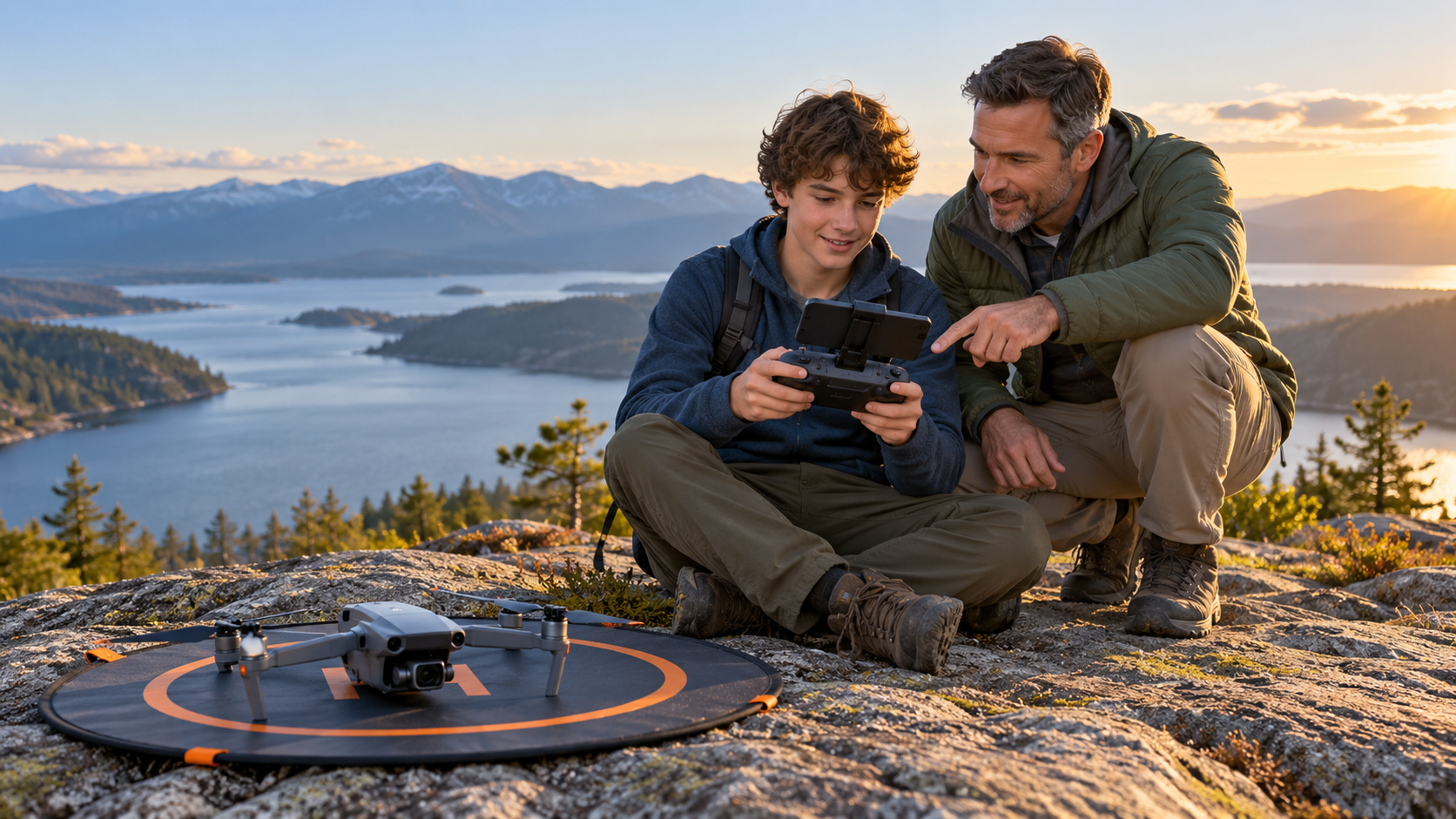
Separate learning to control the aircraft from learning its camera. Begin with the controls on the ground and a supervised orientation plan, after checking the actual location’s rules. Your teen can sketch the photograph while the adult handles responsibilities appropriate to the flight. Thinking about the subject is useful creative work in its own right. There is no need to fly simply to make the first lesson feel complete.
It may be relevant when a specific supervised creative use fits the exact control method and aircraft instructions. Read the complete package details before ordering, including how it is controlled and what is included. An easy-looking launch demonstration is not a substitute for checking the responsibilities that apply to your actual use.
Easy-looking flight features are most valuable after you understand the whole arrangement: the control method, the space you may use and the adult’s responsibilities. A teen interested in framing aerial pictures may enjoy learning those limits with you. A child hoping to fly immediately and independently needs a different expectation. Buy for a supervised project you can realistically support, rather than for the excitement of seeing a tiny camera lift off.
Check the chosen control method
Small size does not remove airspace, permission or privacy requirements. An adult should verify the location, control method and safe practice area before a flight. Your teen needs to understand when to stop and how to keep attention on the aircraft, rather than only the picture. Keep the first session short and within the rules; the goal is a repeatable safe routine, not discovering how far the aircraft can go.
BEST FOR APPROACHABLE CREATIVE FLIGHTS
DJI Neo
DJI Neo is a compact option designed around accessible short-form aerial capture.
It is worth comparing for a teen ready to learn deliberate flight planning with close adult support. Let the intended photographs and the operator’s willingness to learn guide the purchase. GPS features assist operation, but they do not take over the pilot’s duty to understand the aircraft and surroundings.
Learn the exact return behaviour
Match the exact controller, battery count and other included parts. Learn the model’s return-to-home and lost-signal behaviour before relying on it, following its full manual. A familiar-looking package may not be the same kit as another offer. Your teen can help plan a simple sequence from a permitted viewpoint while you check that the equipment, preparation and legal responsibilities are all understood.
BEST FOR FIRST GPS CAMERA DRONE
DJI Mini 4K
DJI Mini 4K offers a compact GPS camera-drone approach with stabilised video.
We would assess its app, controller and complete package alongside the intended picture, rather than assume a price advantage from the model name. A clearly understood system is more useful to a beginner than extra capability that adds another unresolved setup task.
Confirm the app and full package
Check current app compatibility on the device you will use, the actual included pieces and all requirements for the location. Begin only with suitable short, line-of-sight flights under the applicable rules and adult supervision. Have a way to copy and back up the files after the session. The creative project becomes more satisfying when the pictures can actually reach a private album or edit, rather than remain on a card nobody knows how to read.
FOR AN ALTERNATIVE AERIAL SYSTEM
Potensic ATOM SE
Potensic ATOM SE is another compact GPS camera-drone system for a family to compare for an adult-supervised aerial-photo project.
Buy for a small, lawful project
We would favour the simplest aircraft that supports the lawful photographs you want and a routine your teen will take seriously. Setup, updates and preflight checks are part of the decision. Maximum range is not a useful first goal. If the responsibilities are not a good fit yet, a ground-based photography project still offers composition, light and storytelling skills that can support a future interest in aerial images.
Plan the composition on paper
Sketch a simple scene on paper, such as a path between two patches of grass. Mark where the pilot and supervising adult could safely stand. If the photograph depends on leaving a permitted area or flying over people, make another composition plan. Compare the sketch with an existing aerial image when flying is unsuitable. Your teen can discover how lines and shapes lead the eye without any pressure to launch.
Keep the young photographer involved on the ground
A teen interested in aerial photography can contribute before they operate an aircraft. Ask them to sketch the intended composition and identify the main subject, background and edges. An appropriately qualified adult can assess whether the location and flight are permissible and safe. Planning and reviewing images are meaningful creative roles; they are not a consolation prize while someone else does the important part.
Where the rules, manufacturer guidance and supervision allow the teen to learn to operate, keep the first lessons about control. A screen can be distracting before orientation and landing feel familiar. Establish the stop instruction and boundaries in advance, and keep direct sight of the aircraft. Do not let a promising composition become a reason to extend the flight, approach people or ignore changing conditions.
After landing and securing the equipment, review one picture. Look for a line, pattern or scale difference that the aerial viewpoint revealed. A modest crop on a copy may explain the idea more clearly without another launch. Save the original and discuss privacy before sharing. Your teen can learn composition from the result while the adult retains responsibility for the aircraft and applicable requirements.
If flying is unsuitable that day, keep the project alive with ground-based pictures of patterns and lines. The camera lesson can continue without the drone. Safe judgment is part of learning the craft, and sometimes the best decision is to bring home no aerial photograph.
Safety and family rules
An adult should help with registration or training requirements, airspace checks, battery inspection, and launch-site selection. Never fly over people, roads, emergencies, wildlife, or restricted areas.
Our camera guide by experience offers other ways to develop a photography interest. The creative projects include ideas that begin on the ground. A well-planned image, safe operation and a finished collection are the worthwhile goals; the aircraft is only one possible tool for getting there.