
Reviewed and updated: November 10, 2026
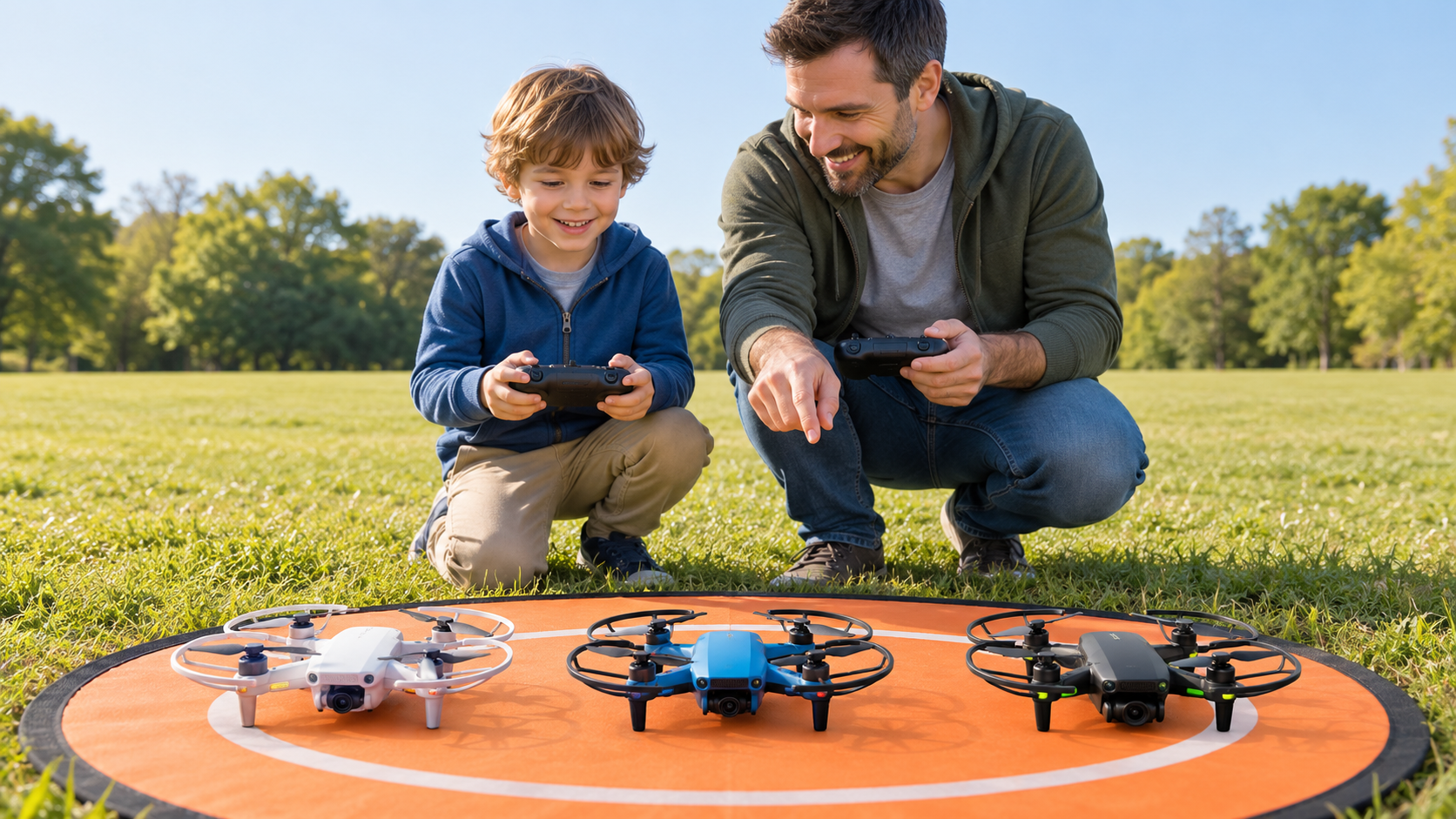
Your child’s first drone adventure can be as simple as lifting off, hovering over an empty patch of floor and making a tidy landing. We recommend starting with a small guarded practice drone rather than making aerial video the first goal. The Holy Stone HS210 and Potensic A20 fit that learning-first approach; the DEERC D20 adds a basic camera once flying itself feels familiar.
A little flight school before aerial photos
Picture a tiny flying lesson, with you beside the controls and plenty of clear space. Your child learns which way the drone faces, how gently to move a stick and when to land. That is the foundation for a future bird’s-eye photo project. A camera adds another thing to watch, so it can wait. Before buying, check the manufacturer’s age guidance, propeller protection and replacement parts for the exact model. A toy-sized drone still needs close adult supervision.
The HS210 makes sense when your child is excited about the flying part. Its small guarded shape suits supervised indoor orientation practice: lift a little, hold position briefly, then come back down. Keeping the first goal this small gives you something clear to celebrate. You don’t need a dramatic flight path or a camera feed to make the session feel like a mission. The useful question is whether your child can follow your landing instruction calmly, even when the drone starts to drift.
A basic trainer is a worthwhile purchase only when you have somewhere appropriate to use it. Think about the adult’s time and the practice space before thinking about extra batteries. Your child can enjoy learning a gentle turn and a controlled landing without needing a camera immediately. A simple aircraft can make that learning easier to follow, but it cannot make a busy room safe or replace an adult who understands how to stop it.
A tiny flight school at home
Expect short sessions rather than an afternoon of continuous flying. That can be a comfortable rhythm for a beginner, with time between flights to talk about what happened. You manage the batteries, charging and inspection, letting batteries cool as directed. Check what the exact package includes and whether replacement guards or propellers are available.
BEST FOR INDOOR BEGINNERS
Holy Stone HS210
A small trainer for learning orientation and stopping in a clear room under appropriate adult supervision.
The Potensic A20 is another guarded practice option if your family wants to work on simple control rather than making videos. Beginner-oriented modes may make an introduction less intimidating, but your child still needs to watch the aircraft and learn what the sticks do. Imagine a pretend delivery mission without attaching a load: take off, hold a steady position and land at the agreed point. The fun comes from getting a little smoother, not from adding obstacles or flying close to people.
Simple practice, with you beside the controls
Automatic hold features cannot make a crowded room suitable for flying. Clear a generous area, keep other children and pets out, and stop if you cannot maintain a safe boundary. Before buying, compare the controller layout and the instructions you will use together. If you cannot explain how to stop the aircraft confidently, postpone the flight. Bundles can contain different quantities of batteries, guards and spare propellers.
BEST FOR SIMPLE PRACTICE
Potensic A20
Potensic A20 offers a compact guarded design and beginner-oriented control modes to compare for a clear, supervised room.
The DEERC D20 introduces a basic camera to the same buying conversation. It is the more relevant option when your child already understands takeoff, hovering, turning and landing, and is curious about seeing a familiar scene from another viewpoint. Keep expectations modest: a camera feature on a beginner drone is a learning extra, not a promise of polished aerial photography. Your child should be able to keep watching and controlling the aircraft without becoming absorbed in a screen.
A camera after the flying basics
For a first camera exercise, discuss the intended view before takeoff and keep the flight itself simple. An adult should assess the location, people nearby, privacy and applicable rules. Never let the search for a better picture stretch the flight beyond direct sight or safe control. The D20 camera arrangement and included battery count matter when planning a short filming session.
BEST FOR A FIRST CAMERA FEATURE
DEERC D20 Mini Drone
A mini-drone option for supervised practice before making photography part of the flying session.
Our recommendation for a first flying adventure
For most first flights, we’d put control ahead of camera features. Compare the HS210 and A20 around their guarded design, clear instructions and the parts you can replace. The D20 becomes more interesting after those basic flying skills are established. A successful first purchase is one you can supervise comfortably and your child can learn to land, even if no photograph comes home that day. You can always revisit aerial photography after the flying lessons have become routine.
Make the first mission a calm landing
Before takeoff, agree on one landing signal and practice saying it without the motors running. Give each of you a separate job: your child follows the controls while you protect the practice area and remain ready to intervene. End with a controlled landing, then ask, ‘Which movement felt easiest?’ That conversation gives the next session a purpose. Keep a paper flight log with one small achievement, such as a calmer turn; there is no need to turn it into a scorecard.
Know what the next lesson is before adding features
After a few calm sessions, ask whether your child can stop, reorient and land without rushing. If those basics are still uncertain, the next useful improvement is another short practice lesson, not a camera or accessory. Make progress visible with a simple note such as ‘landed where we planned.’ Avoid rewards for height, distance or risk. The beginner’s achievement is controlling the aircraft within a safe, agreed space, with you supervising every session.
If the manufacturer’s age guidance or your available space does not fit, wait. A drone does not have to become a child’s first camera, and postponing a flight can be the right decision.
The flying lesson can wait until everyone is ready.
Safety and family rules
Adults must manage lithium batteries and check local flight rules, including any registration, operator or location requirements that apply. Follow the manufacturer’s age and operating instructions. Keep drones away from faces, pets, roads, trees, crowds and restricted airspace. Stop the motors and power down as directed before touching or adjusting the aircraft. Guards reduce some contact risks; they do not make propellers harmless. If the practice space or supervision is unsuitable, save the mission for another day.
If your child mainly wants to bring home pictures, a ground-based camera may be the happier first adventure. Our kids camera guide helps you match that interest to a simpler tool. For creative ideas between flying sessions, browse the photography projects you can enjoy together.