
Reviewed and updated: October 28, 2026
Instant cameras make each frame tangible, which can help children slow down and plan a shot. Film cost, flash behavior, close-focus limits, controls, straps, and adult supervision matter more than novelty colors.
This guide was reviewed against current official product information where a model is discussed. Specifications and packages can change, so verify the exact label or manufacturer page before acting.
Begin with supervision and film cost
Instant cameras eject a physical print after every exposure, so each shutter press has a real consumable cost. Set a project budget and explain that the image will not appear instantly on the film. An adult should load film, manage batteries or charging, and supervise straps, small accessories, and hot vehicles. Choose a camera the child can grip without covering the flash, lens, or exposure sensor. For very young children, a durable digital camera with review and delete may be a better first step than an optical viewfinder and fixed-price film.
Compare Fujifilm Instax Mini 12
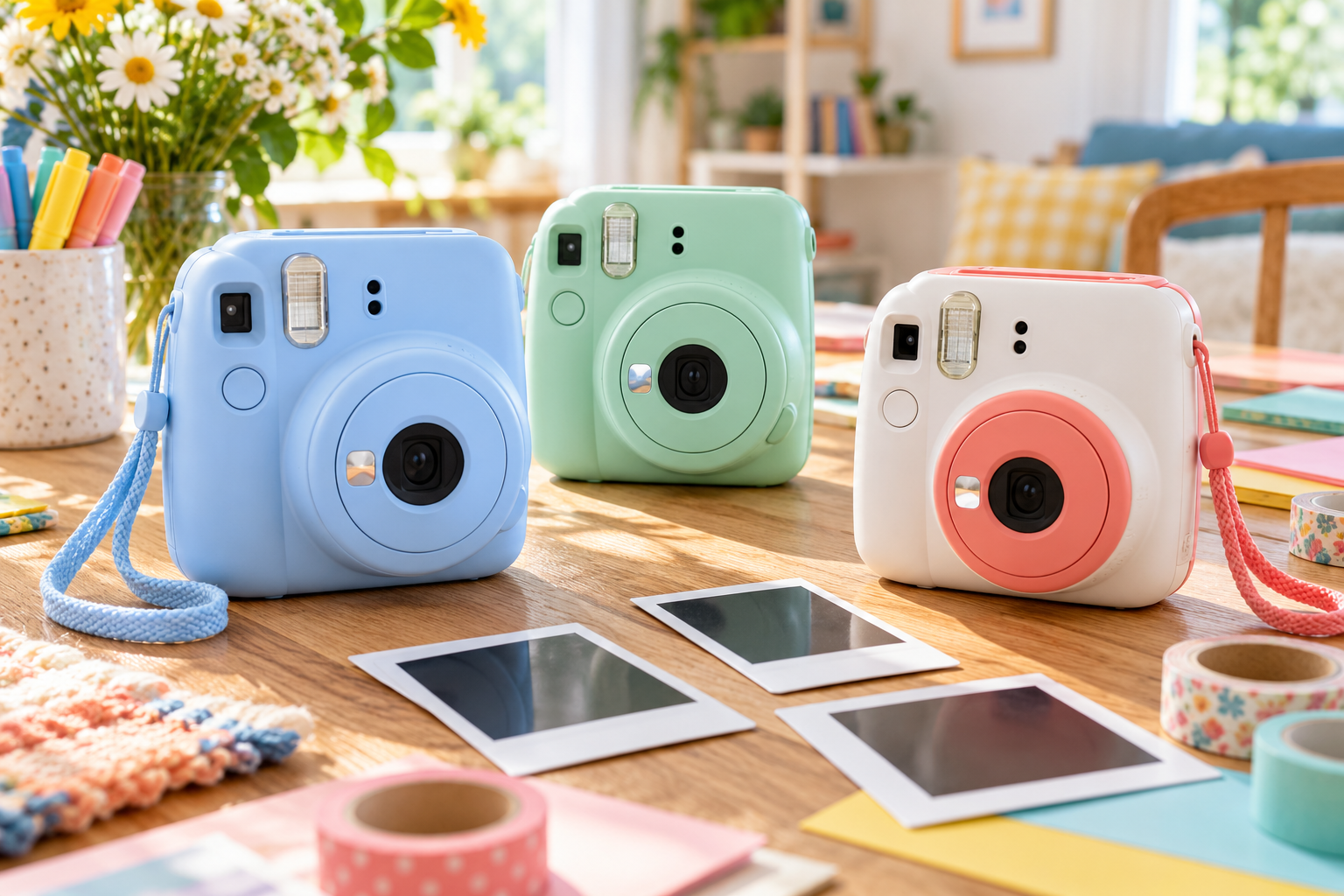
The Instax Mini 12 uses Fujifilm Instax Mini film, automatic exposure, an always-firing flash with automatic light adjustment, and a close-up mode activated by twisting the lens. Its optical viewfinder has parallax considerations at close distance, so children need practice centering subjects and keeping fingers clear. The camera uses two AA alkaline batteries and produces credit-card-size prints. Confirm the current color and package contents, because film is often sold separately. The simple controls suit a supervised family project, but the flash cannot be treated like a screen preview or manually corrected after the frame is exposed.
Compare Polaroid Go Generation 2
The Polaroid Go Generation 2 is a compact analog instant camera that uses Polaroid Go film. Its small body can fit older children and adults who want a portable format, while the tiny viewfinder and controls may be challenging for small hands. The built-in rechargeable battery means charging becomes part of the project plan. Features such as double exposure and self-timer can support creative assignments after the basic loading and framing routine is understood. Verify the complete Generation 2 model and film type, because Polaroid film families are not interchangeable.
Compare Kodak Mini Shot 3 Retro
The Kodak Mini Shot 3 Retro is a hybrid digital camera and dye-sublimation printer that can preview images before printing and can also print compatible phone photos. That reduces wasted prints but adds menus, Bluetooth pairing, charging, and app permissions. The square print format differs from traditional instant film, and cartridges combine paper and color materials. Confirm the exact C300R model, mobile compatibility, and current cartridge pack before purchase. An adult should manage account permissions and wireless setup, while the child focuses on composition and respectful photography.
Choose analog or hybrid workflow
Analog instant cameras reveal the result only after the shutter is pressed and the film develops; this encourages planning but offers no undo. A hybrid camera can show an image first, saving consumables, yet it brings screens and software into the activity. Decide whether the goal is patience, a physical scrapbook, a party station, or a mix of phone and camera prints. Compare the ongoing film or cartridge cost using the exact pack size. Do not buy a camera because inexpensive third-party media looks compatible; use the media specified by the maker.
Teach viewfinder and flash habits
Show the child how the viewfinder sits above or beside the lens and why close subjects may not land exactly where expected. Practice with the camera unloaded or powered off: grip the sides, keep fingers away from the lens and sensors, look for background clutter, and hold still through the shutter action. Do not stare into or deliberately fire the flash near a person’s eyes. Ask permission before photographing anyone, especially at school, events, or private homes. A physical print does not remove privacy responsibilities.
Build a three-frame family assignment
Give each photographer three prompts: one person with permission, one detail, and one place. Set the shooting distance and lighting expectations from the camera manual, then allow only one frame per prompt. Write the date and photographer on the back after the image fully develops, using the recommended marker. Never bend, shake, cut, heat, or peel developing film. Place finished prints in an acid-free album or project board away from direct sun and small children who may mouth them.
Protect the camera and supplies
Use the supplied strap correctly and never hang a camera where it can catch on playground equipment, furniture, or a vehicle. Keep film sealed until loading, follow temperature guidance, and do not open the film door after the pack is installed. Store the camera dry, remove leaking batteries safely, and charge only with the specified equipment. Clean the rollers or paper path only as the manufacturer directs. If a cartridge jams, stop and consult the manual rather than pulling on film or inserting a tool into the camera.
Quick checklist
- Budget for the exact film or cartridge.
- Keep fingers clear of lens, flash, and sensors.
- Teach permission and privacy before shooting.
- Supervise loading, charging, and app setup.
- Never shake, cut, or peel developing film.
- Store finished prints away from heat and sunlight.
Why these checkpoints matter
- Budget for the exact film or cartridge. This defines the starting condition and prevents the rest of the process from resting on an assumption.
- Keep fingers clear of lens, flash, and sensors. This narrows the choice to evidence you can verify on the exact label, model, or scene.
- Teach permission and privacy before shooting. This checkpoint reduces avoidable risk before another variable is introduced.
- Supervise loading, charging, and app setup. This keeps the routine compatible with the person, product, material, or equipment involved.
- Never shake, cut, or peel developing film. This creates a repeatable step instead of relying on memory or marketing language.
- Store finished prints away from heat and sunlight. This final review catches changes in condition, availability, or instructions before the next use.
Common questions
Which instant camera wastes the least film?
A hybrid model can preview before printing, but it adds software and charging. Analog models encourage careful planning but every exposure uses film.
Can different Instax or Polaroid films be swapped?
No. Use the exact film family specified for the camera.
Is an instant camera suitable for a preschooler?
Often only with close adult supervision; grip, optical viewfinder use, flash, small parts, and consumable cost may make a simple digital camera more suitable.
Compare current Amazon listings
Check the exact model, package, seller, current price, and availability.
View product on Amazon (paid link)
Check the exact model, package, seller, current price, and availability.
View product on Amazon (paid link)
Check the exact model, package, seller, current price, and availability.
View product on Amazon (paid link)