
Reviewed and updated: November 10, 2026
A family trip can become a small album of discoveries without asking your child or the camera to test its limits. We would compare OM SYSTEM Tough TG-7 for a growing interest in close-up and other specialist features, Pentax WG-1000 for a straightforward rugged-camera approach, and KODAK PIXPRO WPZ2 for casual supervised snapshots. The camera must fit the actual setting, your child’s hands and the care you can provide. A waterproof rating never replaces an adult’s attention around water.
Read the door and seal instructions
For a beach trip, download the manual for the exact camera before packing. Find the instructions for closing the battery door and cleaning the housing after use. If buying used, ask about drops, cracked latches and replacement seals before counting on its waterproof rating.
A leaf’s pattern or a small nature detail can give those tools a purpose, with an adult helping learn the equipment. Buy for the pictures you want to explore rather than assuming the most elaborate rugged option is necessary for every occasional family outing.
A rugged camera can suit a child who loves noticing small outdoor details, provided you are comfortable taking responsibility for its care. Extra close-up tools have a clearer purpose for that interest than for a family wanting only an occasional holiday snapshot. Consider the camera, carrying arrangement and adult care routine together. The best fit is equipment you will willingly bring along and look after, rather than a protection claim that sounds reassuring on its own.
Decide whether the specialist features matter
The TG-7 may be more equipment than you need for a few casual snapshots. It also needs its own seal-care routine and full model-specific instructions. An adult must inspect and secure the doors before any permitted water exposure. Keep the first session dry and manageable while your child learns where the shutter and playback controls are. Familiar handling gives you a clearer starting point than introducing the camera beside a busy pool.
FOR SPECIALIST NATURE DETAILS
OM SYSTEM Tough TG-7
TG-7 is worth comparing when your family has a real use for specialist close-up and rugged-camera features.
It may appeal when you want a dedicated camera without buying a specialist feature set for a project you do not have. Check the complete manual and exact package as part of the purchase, including the limits that apply to the activities you already manage safely.
Read this model’s own limits
Read the WG-1000’s own depth, duration, temperature, shock and care limits rather than borrowing assumptions from another rugged model. A floating wrist strap may be appropriate only as directed and without creating a snag hazard; it never replaces supervision. Decide which adult handles the equipment and when pictures will be reviewed. Your child can enjoy noticing a bright colour or an interesting detail while the care checks stay firmly with you.
FOR STRAIGHTFORWARD RUGGED USE
Pentax WG-1000
Pentax WG-1000 offers a more straightforward rugged-camera approach for family travel and suitable supervised outdoor pictures.
We would judge it by those ordinary snapshots and the child’s ability to manage the controls, with adult care and supervision. A simple use can be a good reason to buy a camera, provided its actual handling and limits suit the family rather than the adventurous picture on the box.
Prepare the card and controls on dry land
Check its required memory card and practise the operation before the trip. An adult should learn how to inspect, close and secure the compartment according to the WPZ2 manual. Begin with a few dry-land pictures and look at them together. Your child does not need to use every capability to enjoy the camera; a clear first subject and a comfortable grip can be enough to start a useful small collection.
FOR CASUAL FAMILY SNAPSHOTS
Kodak PIXPRO WPZ2
KODAK PIXPRO WPZ2 is relevant for a family wanting straightforward automatic photographs in a rugged compact body.
Give every extra feature a real job
Match the camera to your actual surroundings and care routine. Occasional splashes, permitted water use and dry-land nature details are different briefs. Read the exact model’s depth, time, temperature and maintenance conditions before planning anything wet. We would favour specialist features only when they support an existing interest. If the camera will mainly record ordinary family moments, comfortable controls and a routine you can maintain deserve more weight than an extreme-looking feature list.
Make a dry-land practice round
Make a dry-land practice round with an adult nearby: find the shutter, take one picture and review it. Keep doors, cards and charging with the grown-up. At the pool or beach, supervision remains the first job, with a separate appropriate time for looking through the photographs. A camera should not divide the attention of the adult responsible for the child around water. The family album can wait until everyone is safely settled.
Make the first adventure a dry one
Use the first session to learn the camera in a calm place, even if water resistance was the reason you bought it. Ask your child for a wide view, a texture and a portrait of a patient toy. Find playback together and check that the files transfer to the family device. Keeping this first project dry separates learning the controls from the responsibilities of a pool or beach outing.
A rugged camera can invite interesting observations without any extreme activity. A leaf pattern, a pebble collection or the color of a beach towel can all become part of the trip’s story. Stay within safe, permitted places and do not disturb wildlife for a picture. Your child can notice the small details while you manage the equipment and surroundings.
Afterwards, follow the exact model’s care instructions before opening compartments or putting it away. Sand, moisture and hurried handling are not things to leave for a child to troubleshoot. Plan which adult does the cleaning and where the camera dries or rests as directed. The useful rugged camera is one your family can maintain, not merely one with an appealing protection claim on the box.
If your family’s outings are mostly dry and gentle, compare whether a non-rugged camera already covers the project. Buy waterproof capability because the planned, properly supervised activity needs it. There is no requirement to make the camera prove itself in water to justify the gift.
Safety and family rules
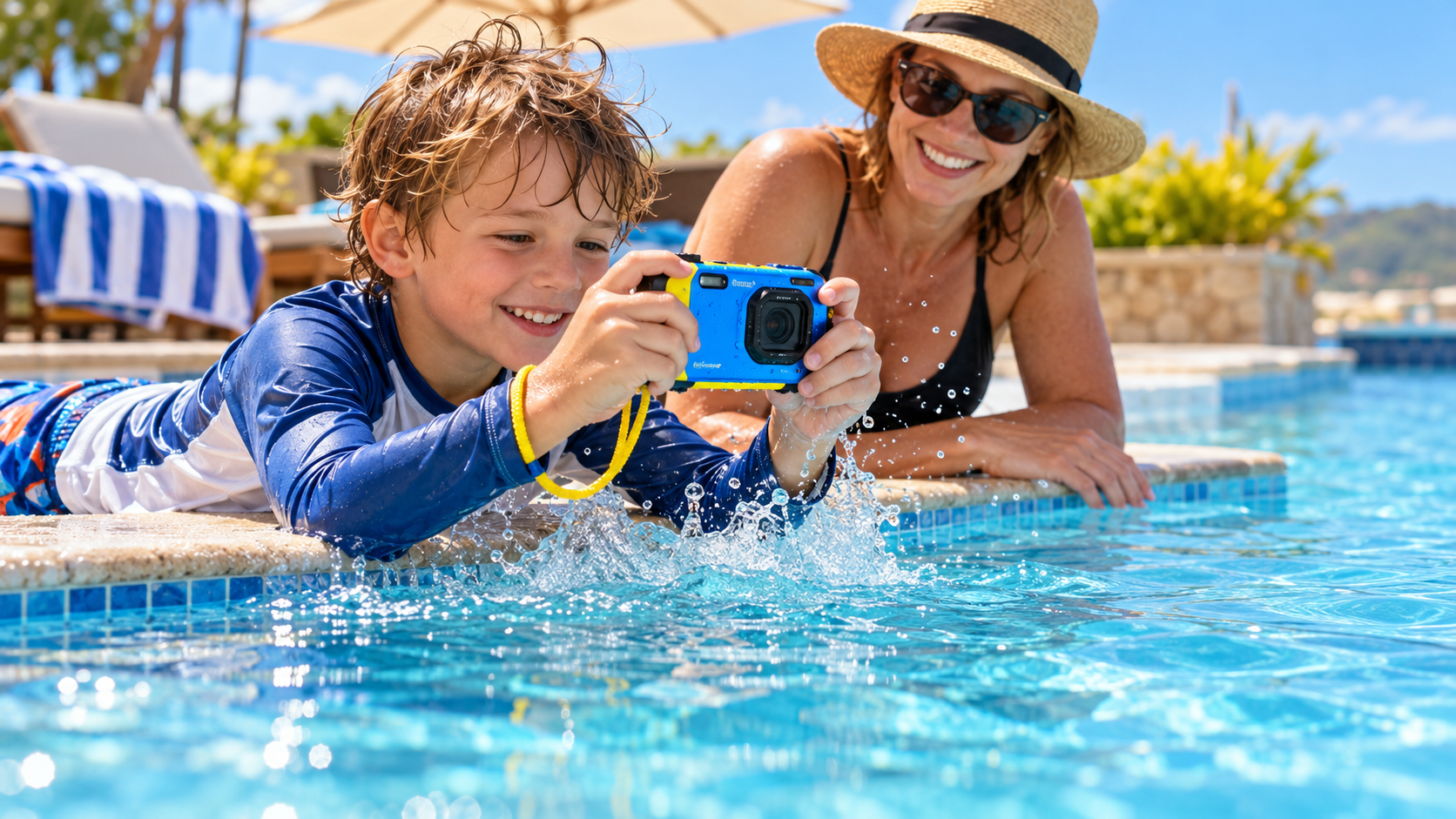
An adult should inspect and close every battery or card door before water use. Rinse salt, sand, or pool chemicals according to the manual, let the camera dry before opening it, and never let photography distract from water supervision.
If you are still deciding what your child can handle, start with our age-by-age camera guide. The photo projects include dry, manageable ways to enjoy a first session. Let your child’s curiosity supply the adventure, while the adult supplies the equipment care and safe boundaries.