
Reviewed and updated: November 10, 2026
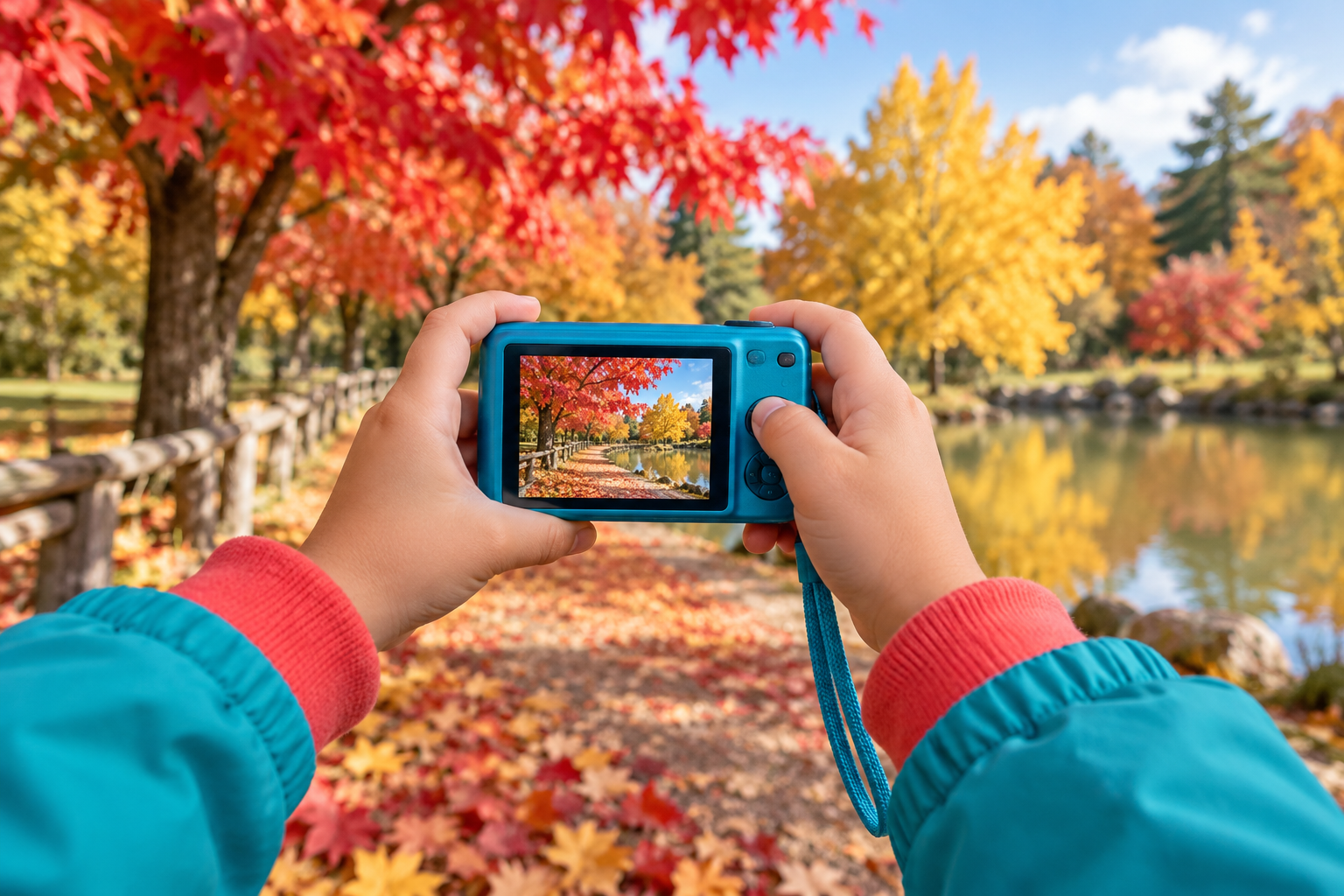
There might be a golden leaf, a stripy shadow and something wonderfully crunchy-looking waiting on your next family walk. Give your child a camera and a small colour mission, and an ordinary autumn path becomes a place full of things to notice. Keep the route short and the safety boundaries clear. You are collecting a few discoveries to enjoy together, rather than trying to photograph every leaf before going home.
A small route with room for discoveries
Pick a park, yard, or neighborhood path with safe walking surfaces and clear adult sight lines. Check weather, sunset time, closures, and local rules. A route that can be completed in thirty to forty-five minutes gives children time to look without becoming cold, tired, or rushed.
Set three simple safety rules
Agree that the photographer stops walking before looking through the screen, stays within the adult boundary, and never steps into a road or restricted area for a picture. Add clothing, visibility, and allergy precautions for the location. The adult manages street crossings and keeps the group together.
Prepare the camera at home
Charge the battery, insert a tested memory card, clean the lens with an appropriate cloth, and set a simple automatic mode. Attach the approved wrist strap and practice holding the camera with two hands. Disable distracting effects if they slow the child down, and confirm the date and time for easier family organization.
Set off on a colour hunt
Give the walk four little clues: something red, something yellow, something green and several colours sharing one frame. Your child can interpret them in their own way, photographing leaves where they are rather than picking them. A favourite colour can lead the search when four clues feel too many. The mission gives the walk direction without making it a race or a competition for the largest camera roll.
Find the little details along the path
Look for rough bark, fine leaf veins, seed-pod patterns or a reflection seen from a safe dry position. Those details can feel like discoveries even on a familiar route. Remind your child to look away from the screen before moving their feet and to stop before taking the picture. If you want to try a close-focus mode, practise at home first so the path does not become a place to wrestle with unfamiliar menus.
See what the light does to a leaf
Stand in one safe place and photograph the same leaf with light from the front, side, and behind. Compare color and transparency on the screen without declaring one correct. Avoid looking toward the sun through optical equipment, and move to shade if the child is squinting or the camera becomes hard to see.
Respect people and places
Ask permission before photographing recognizable people, homes, artwork, or private property. Do not share location clues, school logos, or another child’s face without guardian approval. Leave plants, wildlife, and decorations as found. The strongest family rule is that a person can always decline a photo.
Bring home a handful of favourites
At home, let your child pick five favourites and tell you what caught their eye. Back up the files before deleting anything, then give the selection a name. A small collage or a printed favourite can make the walk feel complete. Point out something specific they noticed, such as a repeated shape or a contrast of colours. The photographs are a way to see their version of the outing, without needing a public audience.
Quick checklist
- Pick a short safe route.
- Charge and test the camera.
- Stop walking before framing.
- Use color and texture missions.
- Ask permission for people and property.
- Back up before choosing favorites.
Collect the same color in different light
For another short mission, follow one leaf colour through different safe positions and light. Compare it in open shade, with light coming through it from behind, and beside a contrasting background, keeping optical equipment away from direct sun. Take a few pictures and ask which shows the edge most clearly. Your child can describe the difference in ordinary words; the interesting part is seeing how the same colour changes.
Common questions
What camera settings should a child use?
A reliable automatic mode is enough; the goal is noticing and composing rather than managing many controls.
What if the weather changes?
Turn back early when surfaces, visibility, temperature, or lightning make the route unsafe.
Should children post their photos?
Review privacy, location, and permission together before any sharing.
Make a small colour collection from the finished pictures. Your child could arrange red, gold and green photographs in a line, or put all the textures together. Ask what order feels right and why. The collection does not need to include every clue to be worth keeping. A clear little selection can show you what they enjoyed most about the walk.
Save a favourite location idea for another day and keep the original photographs in your family backup. You can visit the same safe route again to see what has changed, checking conditions and local access before setting off. A path does not have to be new to offer a new picture: the light, leaves and the things your child notices may all be different.
End while the outing still feels enjoyable. Let your child choose a title for the album—The Golden-Leaf Hunt or something entirely their own—and put the camera away together. You can keep the next mission as small as one colour or one texture. The lasting habit is looking closely, with a grown-up watching the route and a young photographer deciding what deserves a picture.
Let the colors become a tiny collection
Give each photographer a slightly different theme: the brightest leaf, three shades of one color or a picture in which autumn is only a small detail. You can work along the same safe route without competing for identical subjects. A younger child might collect three favorites; an older child could photograph one tree from several reachable positions and explain which composition feels most seasonal.
Back at home, put the pictures in a small private album and let your child arrange them from quiet colors to bold ones. Ask whether a close detail or a wider scene makes the better opening. Keep the originals safe before cropping copies. The walk has now become a little visual collection, with choices your child can explain, rather than a phone full of leaves that never gets looked at again.
Choose a safe familiar spot you can revisit later in the season. Comparing the same view gives changing colors a story beyond a single day’s collection.