
Reviewed and updated: November 10, 2026
A toy portrait can become a scrapbook treasure, and a birthday guest can leave a photograph beside a message. Instant cameras make those little keepsakes part of the activity. We would begin with the instax Mini 12 for simple supervised film photography, compare Polaroid Go Generation 2 for its smaller format, and consider Kodak Mini Shot 3 Retro when previewing before printing matters more. The fun depends on matching your child’s project, handling and refill plan.
Begin with supervision and film cost
An analogue instant camera uses film each time the shutter clicks, and the picture needs time to develop. Agree on a comfortable number of photographs before the first afternoon, then let your child decide what deserves one. An adult should load film, manage batteries or charging and supervise straps and small accessories. Keep the kit out of hot vehicles. For a very young child who wants endless attempts, a durable digital camera with review and delete may be a happier beginning.
Compare Fujifilm Instax Mini 12
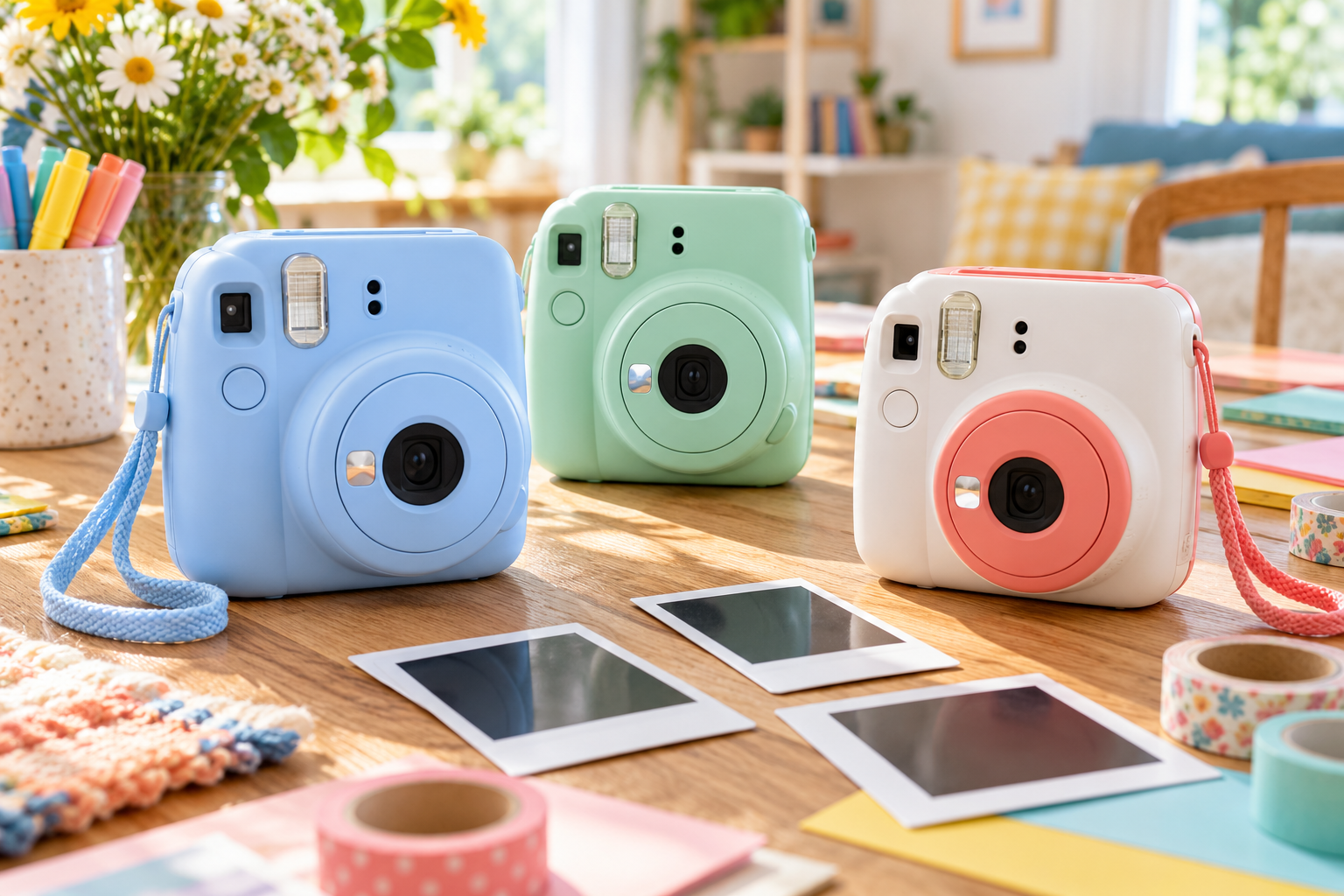
The instax Mini 12 makes small bordered keepsakes for a first photo collection. Its twist-lens operation, automatic exposure and close-up mode keep the controls straightforward, while an always-firing flash uses automatic light adjustment. Practise framing and keeping fingers clear: the optical viewfinder sits apart from the lens, especially relevant up close. It needs instax Mini film and two AA alkaline batteries. Check the exact package, because film is often separate. There is no preview or correction after a film exposure.
Compare Polaroid Go Generation 2
Polaroid Go Generation 2 is worth comparing when your child likes the idea of a tiny photo collection you can carry. It uses Polaroid Go film and a built-in rechargeable battery. The compact body saves space, but its small viewfinder and controls may be difficult for small hands. Once basic framing and adult-managed loading feel familiar, double exposure and a self-timer offer more creative possibilities. Match the complete Generation 2 camera and Go film; other Polaroid film families are not interchangeable.
Compare Kodak Mini Shot 3 Retro
Kodak Mini Shot 3 Retro takes a different route: its digital camera and dye-sublimation printer let you preview a picture before using a print. It can also print compatible phone photographs. That suits a family who wants to select favourites for a square-format project, but adds menus, Bluetooth pairing, charging and app permissions. Check the exact C300R model, mobile compatibility and matching paper-and-colour cartridge pack. You manage wireless setup and permissions while your child thinks about the scene.
Choose analog or hybrid workflow
For an analogue camera, part of the excitement is waiting to see the picture, with no undo for that film frame. A hybrid model lets you inspect it first and print a selection, while bringing a screen and software into the activity. Imagine the first finished project: a tiny scrapbook, a few party keepsakes or a mix of phone and camera photographs. Compare the cost of the correct film or cartridge pack by its usable print count. Similar-looking media is not a substitute for what the manufacturer specifies.
Teach viewfinder and flash habits
Show the child how the viewfinder sits above or beside the lens and why close subjects may not land exactly where expected. Practice with the camera unloaded or powered off: grip the sides, keep fingers away from the lens and sensors, look for background clutter, and hold still through the shutter action. Do not stare into or deliberately fire the flash near a person’s eyes. Ask permission before photographing anyone, especially at school, events, or private homes. A physical print does not remove privacy responsibilities.
Build a three-frame family assignment
Give each photographer three prompts: one person with permission, one detail, and one place. Set the shooting distance and lighting expectations from the camera manual, then allow only one frame per prompt. Write the date and photographer on the back after the image fully develops, using the recommended marker. Never bend, shake, cut, heat, or peel developing film. Place finished prints in an acid-free album or project board away from direct sun and small children who may mouth them.
Protect the camera and supplies
Use the supplied strap correctly and never hang a camera where it can catch on playground equipment, furniture, or a vehicle. Keep film sealed until loading, follow temperature guidance, and do not open the film door after the pack is installed. Store the camera dry, remove leaking batteries safely, and charge only with the specified equipment. Clean the rollers or paper path only as the manufacturer directs. If a cartridge jams, stop and consult the manual rather than pulling on film or inserting a tool into the camera.
Plan a three-print gift
Let your child plan a miniature three-picture album: a willing person, a shared object and a short handwritten message. Lay three paper rectangles on the page first so you can see how much room the prints will need. If the real format is smaller than the sketch, simplify the subject. A little scene with one clear star usually gives a small print more to say than a busy picture full of tiny details.
Common questions
Which instant camera wastes the least film?
A hybrid model suits a family who wants to pick the picture before using a print, provided you are comfortable with the software and charging. Analogue models make each film frame a more deliberate choice. Neither approach is automatically more fun: your child may love the surprise of a developing picture or prefer deciding which digital attempt belongs in the album.
Can different Instax or Polaroid films be swapped?
Use the exact film family specified for the camera. Let your child help label the storage box with that name, so finding the next pack is simple. Go, Mini and other instant formats are not interchangeable, even when their white-bordered pictures look related. An adult should check compatibility and manage loading rather than force a cartridge that does not fit.
Is an instant camera suitable for a preschooler?
For preschoolers, look at grip, viewfinder use, flash and small accessories as well as the refill commitment. Close adult supervision is important, and a simple digital camera can be more suitable for repeated practice. The best first afternoon is one your child can enjoy comfortably, with a few manageable choices and an adult taking care of setup. A physical print is a lovely extra only when the camera itself fits the photographer.
Manufacturer references
Find the camera on Amazon
Match Instax Mini film and allow for practice exposures.
A simple instant-film starting point for a few planned keepsakes.
Find in Amazon (paid link)
Check the exact generation, grip and matching film before making an album plan.
A compact choice for little Polaroid Go prints.
Find in Amazon (paid link)
Check the matching cartridge system.
A hybrid camera-and-printer option when reviewing a picture before printing fits the project.
Find in Amazon (paid link)