
Reviewed and updated: October 17, 2026
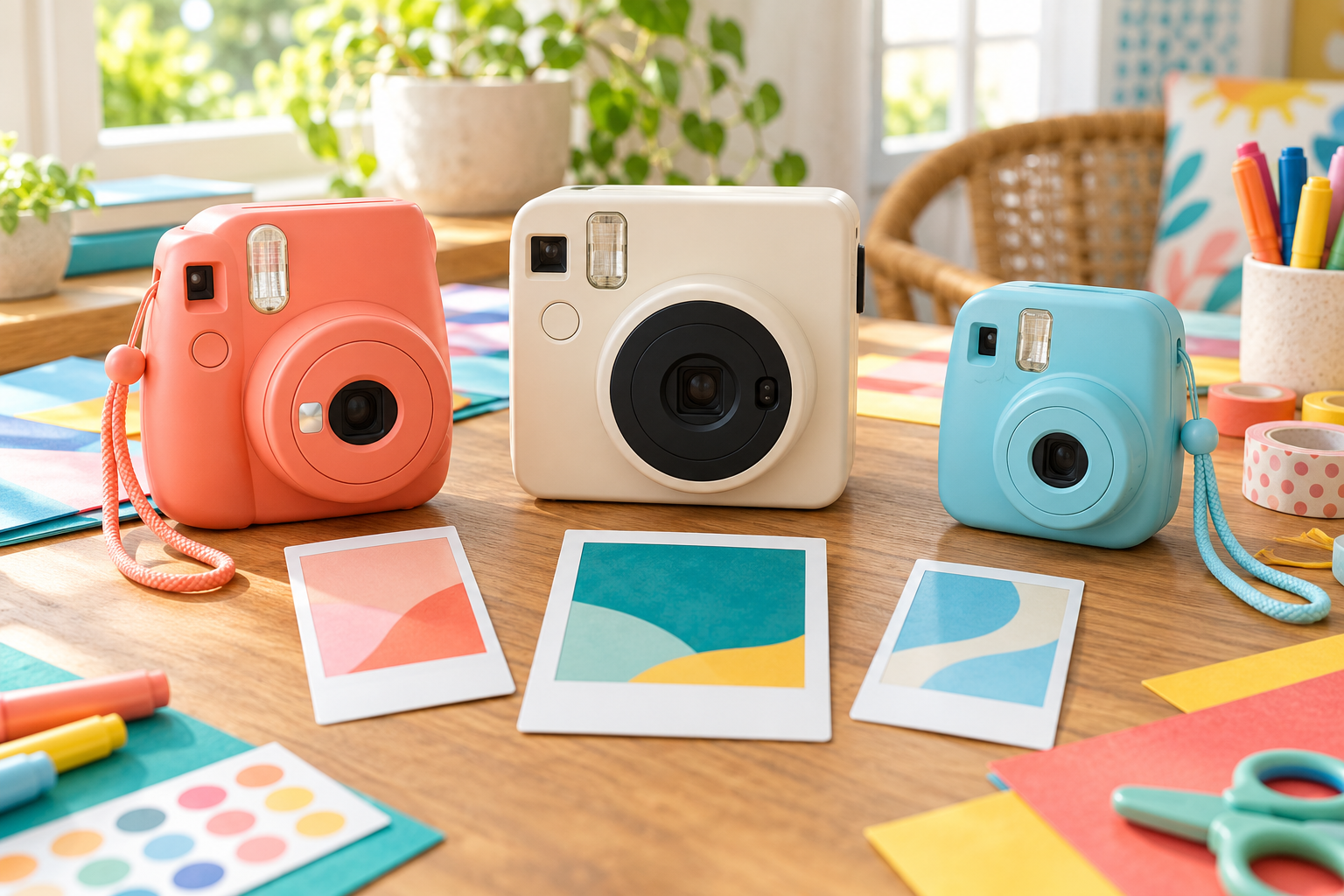
Instant cameras make photography tangible, but film format, flash behavior, close-focus distance, controls, grip, and ongoing film cost matter more than color alone.
This guide was reviewed against current official product information where a model is discussed. Specifications and packages can change, so verify the exact label or manufacturer page before acting.
Choose the film format first
The camera price is only the beginning. Mini, square, and Polaroid Go formats use different film, produce different image areas, and are not interchangeable. Estimate how many prints the family will make each month and confirm film is easy to find. A smaller print is portable and often simple to share; a square frame offers more room for groups; Go film produces a tiny keepsake. Let the child hold sample print sizes before deciding which format feels satisfying.
Compare current models by exact name
Fujifilm’s current instax mini 12 page lists automatic exposure, close-up mode, a selfie mirror, and automatic flash adjustment. Polaroid’s current Go range now highlights Generation 3, while older Generation 2 packages remain in stores. That distinction matters for specifications, accessories, and price comparisons. Read the box and official page rather than relying on a color photograph. When comparing a square-format option, verify the exact generation and film name because similarly shaped cameras may use incompatible cartridges.
Keep operation simple
A child-friendly camera should have an obvious power control, secure wrist strap, visible film counter, and a shutter button that can be pressed without changing grip. Automatic exposure reduces menus but does not guarantee every frame. Flash may fire automatically, and close-focus modes have minimum distance requirements. Practice loading with an adult, never open the back until the pack is finished, and keep fingers away from the lens, flash, exposure sensor, and film exit slot.
Plan for close-ups and selfies
The instax mini 12 uses a twist-to-close-up mode and specifies a close range of roughly 30 to 50 centimeters. Its selfie mirror helps framing, but children still need to keep the camera steady and avoid blocking sensors. Polaroid Go models use their own focus and framing behavior. Read the quick-start guide together and mark a safe practice distance with objects on a table. A few deliberate tests teach more than wasting a full film pack on uncertain arm-length selfies.
Consider size and grip
A tiny camera travels easily but may be awkward for small hands if the grip is shallow. A larger square camera may feel more stable while taking up more space in a backpack. Use a wrist strap every time, choose a case that does not press the shutter, and avoid neck straps that create entanglement risk for young children. Adult supervision matters around stairs, water, traffic, crowds, and pets. Instant cameras are not waterproof unless the exact model says so.
Teach film handling
Fresh instant prints need time and ordinary protection while chemistry develops. Follow the film maker’s directions; do not shake, bend, peel, or heat the print. Keep film within its recommended storage range and let refrigerated packs reach room temperature before opening. Shield unused packs from airport X-ray equipment according to current manufacturer guidance. Write dates on the border only with an appropriate pen after development. Store finished prints away from prolonged direct sunlight and moisture.
Protect privacy and expectations
A physical print can still reveal faces, school uniforms, addresses, mail, or locations. Ask permission before photographing or giving away someone’s image. Make family rules about which pictures may leave home or be scanned into an app. Film limits can encourage thoughtful framing, but mistakes still happen. Budget a few practice frames and avoid scolding a child for imperfect exposure. The goal is observation and storytelling, not a perfect cost-per-print score.
Pick the best fit
Choose instax mini 12 when simple automatic operation and widely recognized mini film fit the plan. Consider Polaroid Go Generation 3 when the smallest format and creative Polaroid experience appeal, but verify current film supply. Compare a current square-format camera when larger prints and group framing matter more than compactness. Official specifications establish features; the affiliate searches help compare current packages without claiming that every marketplace listing is identical or continuously available.
Quick checklist
- Choose film size before camera color.
- Verify the exact model generation.
- Budget ongoing film use.
- Use a wrist strap and adult loading help.
- Teach safe print handling and privacy.
- Compare current packages without assuming accessories.
Why these checkpoints matter
- Choose film size before camera color. This defines the starting condition and prevents the rest of the process from resting on an assumption.
- Verify the exact model generation. This narrows the choice to evidence you can verify on the exact label, model, or scene.
- Budget ongoing film use. This checkpoint reduces avoidable risk before another variable is introduced.
- Use a wrist strap and adult loading help. This keeps the routine compatible with the person, product, material, or equipment involved.
- Teach safe print handling and privacy. This creates a repeatable step instead of relying on memory or marketing language.
- Compare current packages without assuming accessories. This final review catches changes in condition, availability, or instructions before the next use.
Common questions
What age is right for an instant camera?
Read the manufacturer’s age and safety information and judge the child’s ability to handle the camera, film, flash, strap, and privacy rules with supervision.
Should instant photos be shaken?
No. Follow the film instructions and let the print develop normally without shaking, bending, heating, or peeling it.
Are all instax films compatible?
No. Mini, Square, and Wide are different formats. Match the exact film name printed on the camera and manual.
Official product references
Compare current Amazon listings
Check the exact model, package, seller, current price, and availability.
View current options on Amazon (paid link)(paid link)
Check the exact model, package, seller, current price, and availability.
View current options on Amazon (paid link)(paid link)
Check the exact model, package, seller, current price, and availability.
View current options on Amazon (paid link)(paid link)
Keep the decision useful
Write down the exact model, label, starting condition, and result. Change one variable at a time and return to the official instructions when anything is unclear. A short record makes the next decision easier and keeps an isolated result from becoming a rule that does not fit a different product, person, material, or environment.
Review the information again before repeating the process. Stop when comfort, safety, condition, or the manufacturer’s instructions provide a reason to stop. A useful routine stays simple because every step answers a real question.