
Reviewed and updated: November 10, 2026
A charged camera means your child is ready for another photo adventure, but battery care belongs to a grown-up. You handle charging, changing cells, inspection, storage and disposal. Your child only needs a simple rule: stop using the camera and ask you for help if something seems wrong. Keeping those jobs clear lets them concentrate on the photograph while you look after the part they should not experiment with.
Identify the battery type
Check the camera’s label and manual for its exact battery system. It may use alkaline cells, rechargeable AA batteries, a removable lithium-ion pack or a sealed battery. Those are not interchangeable just because a battery looks similar or a cable fits. Keep the correct battery and charger details with the kit, especially when another adult will help. Your child can tell you when the battery indicator is low; choosing a replacement remains an adult’s job.
Keep charging adult-managed
Charge only with the equipment specified for the device, on a hard, dry surface with ventilation. An adult should connect, monitor and disconnect it. Keep charging away from bedding and do not leave it unattended or running overnight. A regular grown-up charging spot makes preparation predictable: your child can bring you the camera after a session, then collect it when you say it is ready. The charging lead is equipment, not part of the play area.
Inspect before use
Stop using batteries that are swollen, leaking, cracked, punctured, wet, unusually hot or corroded. Follow the manufacturer’s instructions and local safety guidance for handling a damaged pack; do not ask a child to inspect, remove or carry one. Keep people away if the situation is unsafe and seek appropriate help. A camera that repeatedly behaves unusually needs attention before the next outing, rather than another attempt to see whether it will work this time.
Prevent short circuits
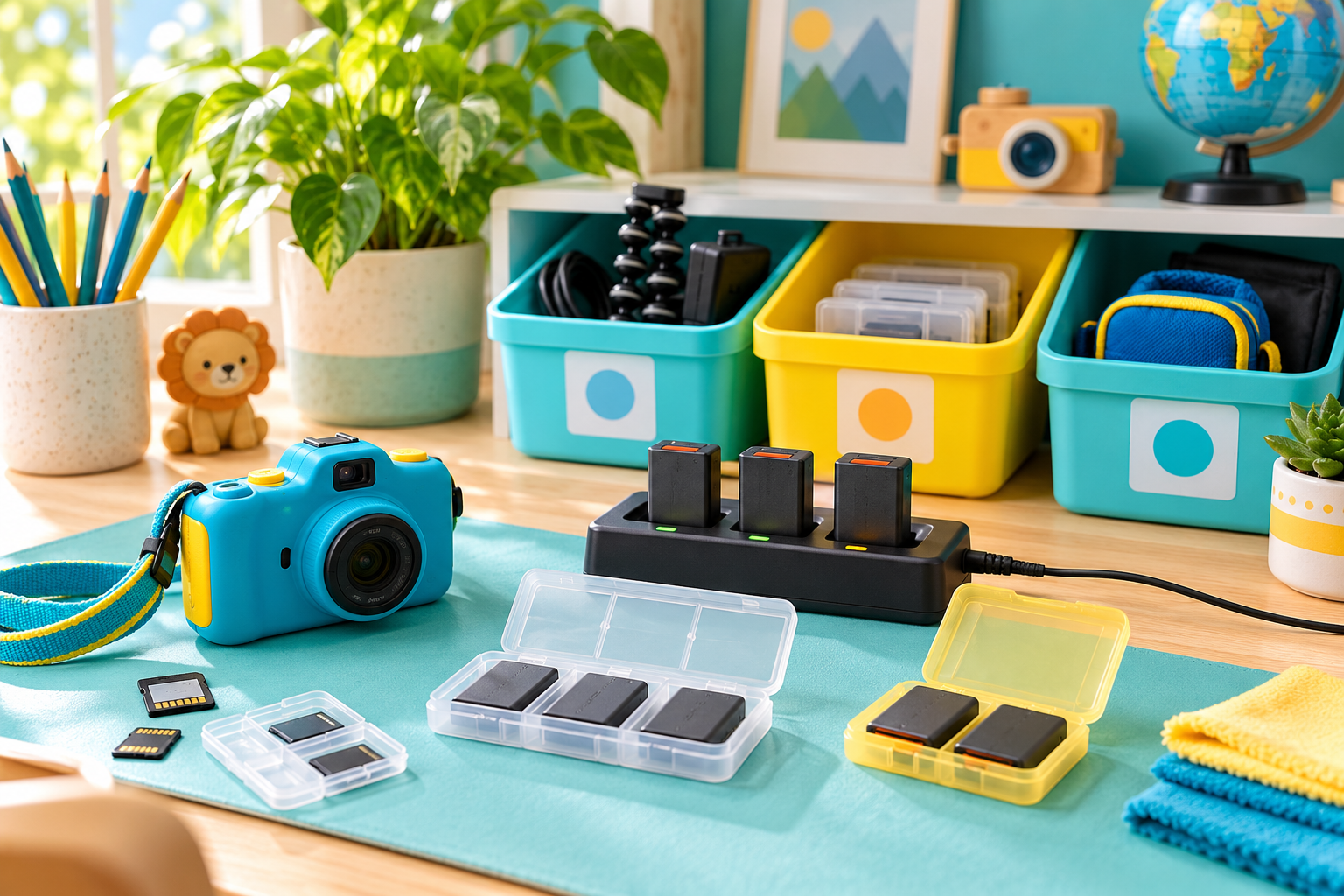
Store spare batteries in separate suitable cases or with the recommended terminal protection. Keep them away from coins, keys, jewellery, metal toys and water. Loose cells do not belong in a child’s pocket or mixed into a bag of craft supplies. Packing can still be a shared routine: your child gathers the album or chooses the toy subject, while you check and secure the battery supplies. That division keeps the camera kit ready without making battery handling a child’s responsibility.
Install with the camera off
When replacing batteries, follow the polarity markings and seat them without force. Never mix old and new cells or different battery chemistries in the same device. Check the compartment and follow the manual’s closure instructions. An adult should do the replacement, with spare and used cells kept out of young children’s reach throughout. If the compartment is damaged or will not close properly, stop using the camera until the problem is resolved through the manufacturer’s guidance.
Teach a stop rule
Teach your child to stop if the camera becomes unusually hot, smells odd, shows an error or shuts down repeatedly. They should tell an adult, rather than open the compartment or keep trying buttons. Do not ask them to move hot or damaged equipment. You can practise the words ‘My camera needs help’ as part of the first lesson, alongside finding the shutter. Recognising a reason to stop is a useful camera skill too.
Store out of reach
Button cells and other small batteries can be swallowed and must stay secured away from young children and pets. Keep new, used and spare batteries in adult-controlled storage, including while changing them. Do not leave a used cell beside the camera to deal with later. The same applies to loose chargers and accessories. A tidy camera shelf is useful only when its dangerous small parts are actually inaccessible, rather than simply labelled or placed with the other equipment.
Travel with care
Before flying, review the FAA’s current battery-packing guidance and your airline’s rules. Spare lithium batteries belong in carry-on baggage, with terminals protected; check the rules for your exact batteries and any limits or approvals. Keep damaged batteries out of the travel kit. This is a planning task for an adult before the trip, rather than a decision to improvise while your child waits at the airport with a camera bag.
Recycle correctly
Do not put rechargeable lithium packs in household rubbish. Use an approved collection route and follow local fire-safety and disposal instructions, particularly for a damaged battery. An adult should manage the whole handover and keep used batteries secured until then. Replacing a battery is not the end of the job if the old one remains loose in a drawer. Add disposal to your grown-up camera routine so the next family photo session starts with a safe, organised kit.
Make a battery card for the camera bag
Make a small reference card with the battery model and approved charger copied from the camera manual. Keep it with the bag so a grandparent or teacher can find the right equipment. Before an outing, you check the camera, supplies and charging; your child checks that they have an idea for a picture. That is enough of a shared routine. A leaf hunt or teddy-bear portrait can be their next adventure while you keep the battery work firmly in adult hands.
Quick checklist
- Identify the battery type
- Keep charging adult-managed
- Inspect before use
- Prevent short circuits
- Install with the camera off
- Teach a stop rule
When another grown-up takes the camera
Before a grandparent, teacher or sitter supervises a camera session, show them the actual equipment rather than only describing it. Point out the approved charger, the secure battery storage and the place where charging is managed. Tell them which tasks remain adult-only. If you cannot provide the correct equipment and clear instructions, send the camera already prepared for the session instead of asking someone to improvise a charging arrangement.
For a school or club camera shared by several families, keep responsibility explicit. One adult checks the kit before handover and another accepts it; batteries should not pass between children as loose supplies. Record a fault so the next person does not mistake an unreliable camera for a flat battery. Do not add a homemade repair or unidentified spare to keep a project running. A paused photo session is easier to rearrange than an unsafe battery situation.
Your child can have an age-appropriate preparation job that does not involve power equipment: select the subject, find the project notebook or remind you that the camera needs attention. Thank them for reporting a problem promptly. That keeps the stop rule useful, without making a young photographer feel responsible for diagnosing or fixing the equipment.