
Reviewed and updated: November 10, 2026
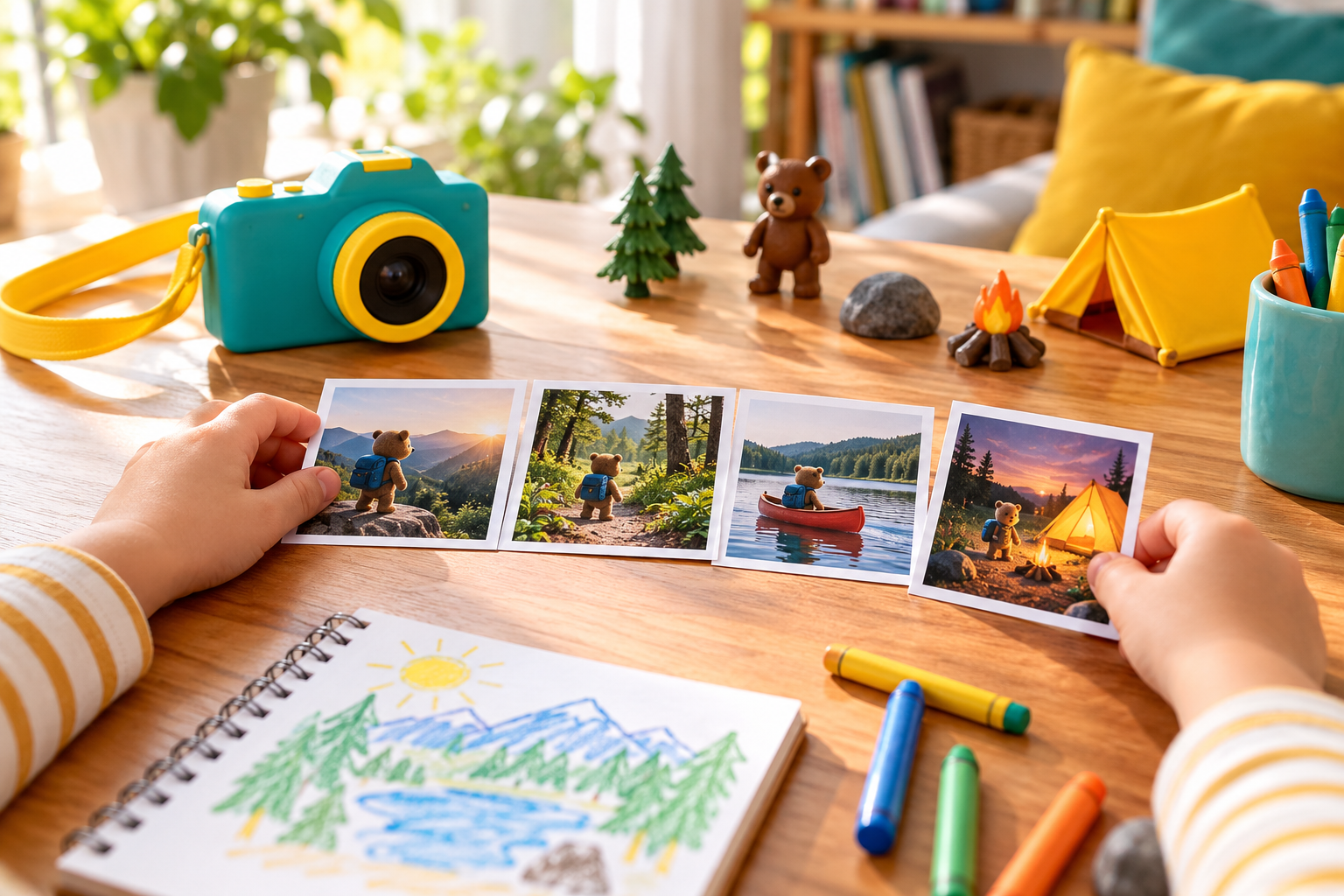
A teddy bear leaves home, finds a mysterious parcel and brings it back to the toy shelf. Three photographs can tell that whole little adventure. Invite your child to invent a beginning, a change and an ending, then use a familiar camera to show you what happened. You help keep the place and activity safe; they decide what the viewer should notice. A small finished story is more satisfying than an enormous assignment that never reaches its last picture.
Begin with three pictures
Begin by asking your child to tell the story aloud in three moments. A toy’s outing, a block tower being built or a snack prepared by an adult can all work. Pick something calm enough to photograph without rushing or repeating risky actions. You approve the location and any tools, food, pets or movement involved. Once the plan feels manageable, the camera has a clear job: show what is there, what changes and how the adventure ends.
Plan with simple picture cards
Draw three empty boxes and let your child sketch the photographs. Stick figures and scribbles are enough; this is a map, not a drawing test. Talk about the subject, viewpoint and order while there is still room to change the plan. Older children can add a sentence below each box, while younger storytellers explain it aloud. The sketch helps you spot a missing step before anyone has taken a picture.
Use wide, medium, and close views
A wide picture can introduce the toy’s world, a medium view can show the action and a close detail can reveal the surprise. Let your child try those distances from safe positions. They do not need to move nearer by foot around roads, stairs, water, ledges or active play. You can move the scene somewhere suitable instead. The useful discovery is how a different view changes what the audience learns.
Keep the camera steady
Use two hands, tuck elbows comfortably, pause breathing for the press, and wait a moment before lowering the camera. A tabletop or stable surface can help. Avoid improvised supports that can fall. If the camera has a strap, fit it according to the maker and supervise cords around young children.
Photograph actions in stages
A story can feel adventurous without the photographer taking a risk. A stuffed animal can cross a room, leaves can move from a basket into a collage, or ingredients can wait on a table before an adult cooks. Photograph safe stages rather than asking someone to repeat a dangerous movement. Your child can create the excitement through the order of the pictures, a surprising detail or the title they give the finished sequence.
Review before taking more
Look at the first three pictures together. Ask what the viewer finds out first, what changes and whether the ending makes sense. Pick one thing to try again, such as moving a distracting object or showing the important detail more clearly. Your child may have a reason for a funny angle or a blurry frame, so let them explain. You are helping the story communicate, not marking their taste.
Protect privacy by design
Use toys, hands, objects, and controlled family spaces when possible. Do not photograph names, addresses, school information, screens, mail, license plates, or other children without permission. Remove location metadata when appropriate and keep account credentials with an adult. A good story does not require revealing personal details.
Edit the sequence, not the memory
Let your child arrange the strongest three to six photographs and tell the story as you look. Small crops or light adjustments may help, using copies after you have backed up the originals. A printed contact sheet or private slideshow makes it easy to move pictures around and compare orders. Keep the decisions small enough to finish: the best ending for today may be a complete three-frame tale rather than another hour of editing.
Repeat with a new constraint
Next time, give the story a small twist. It could use only one colour, happen in one room or be told from the toy’s viewpoint. Those limits invite new ideas without needing a new camera. Finish by letting your child name the story and tell you one choice they would use again. A title such as The Missing Biscuit can make an ordinary sequence feel like a production of their own.
Quick checklist
- Plan a beginning, change, and ending.
- Use wide, medium, and close views.
- Choose calm, supervised activities.
- Review after each short sequence.
- Remove identifying details.
- Back up originals before editing.
Try the silent-story test
For a friendly audience game, give the three photographs to someone who was not there and ask them to put the story in order. Listen to the clues they use. If two orders both seem possible, your child can make the middle picture clearer, perhaps showing a hand place the last puzzle piece. Treat the viewer’s response as an interesting discovery. It is a way to learn what a picture communicates, not a test anyone has failed.
Common questions
How many photos should a child take?
Three pictures are a good beginning. When those show a clear change and ending, your child can grow the next story to five or six. Add a frame because it reveals something useful, rather than because a longer sequence seems more impressive. A short story people can follow gives them a satisfying finished result and an idea to build on.
Does the child need a printer?
Printing is optional. You can arrange the pictures on a tablet or make a private family slideshow and learn the same sequencing skill. Let your child introduce the story and decide when to move to the next frame. A small audience at home can be enough to make their work feel worth sharing, without needing a public account or a printer.
What if the photos are blurry?
If the pictures are blurry, try one steady-hold idea and better light before introducing more settings. Keep the original attempts so your child can see what changed. They do not need every detail corrected at once. A finished toy adventure with a clear idea is a good reason to enjoy the camera again, and the next little story gives you another chance to practise.
Let the ending change the story
Once the first three-frame story works, keep its opening and try a different final picture. The teddy could find the parcel empty, discover a tiny toy inside or leave it as a gift. Ask your child how the same beginning now feels different. You can make that discovery with one carefully planned extra frame, rather than restarting the whole project or adding a long editing lesson.