
Reviewed and updated: November 10, 2026
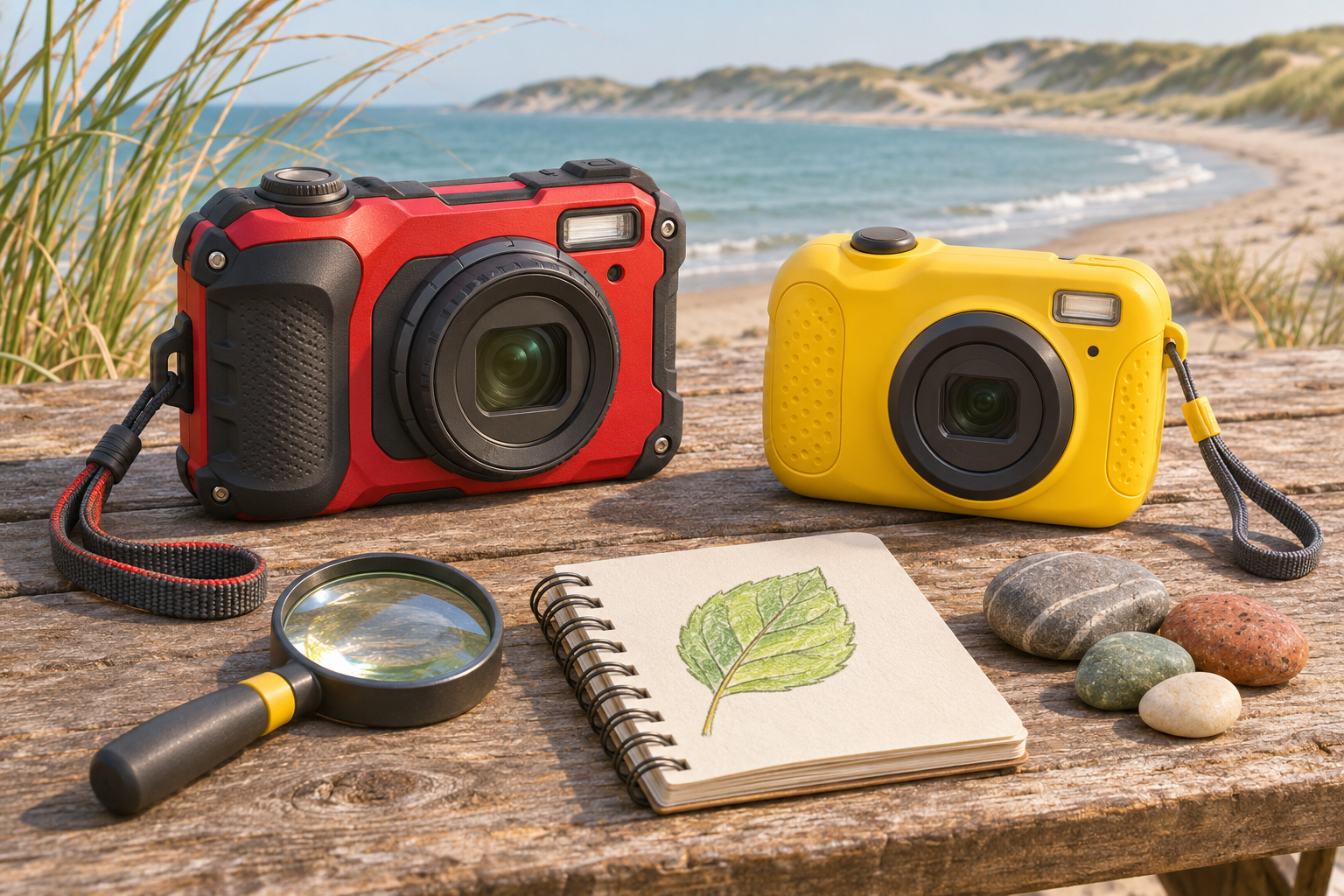
A leaf can look like a tiny forest when your child gets curious with a camera. We recommend the OM SYSTEM Tough TG-7 for families who want to explore close-up nature pictures together, with RAW files and 4K video available as that interest grows. The KODAK PIXPRO WPZ2 is a more straightforward match for outdoor snapshots and Full HD clips. Both are real cameras that need adult-managed care, so start with the pictures your young explorer wants to make.
A camera for your young explorer
These cameras suit a supervised move beyond toy-camera play. Your child might be ready to frame a campsite, inspect a stone’s texture or document a family outing, while you handle charging, seals and storage. Neither camera makes instant prints, and rugged does not mean indestructible or safe to use without supervision around water. The right purchase combines an interesting photo project with equipment your child can hold comfortably and a care routine you can support.
The TG-7 has a 12-megapixel sensor, RAW capture and close-up modes for developing interests.
OM SYSTEM Tough TG-7 Digital Camera
Explore leaf veins, toy details and small discoveries together.
Find in Amazon (paid link)
Record family outings with a 16-megapixel sensor, 4× optical zoom, a 2.7-inch display and Full HD video.
KODAK PIXPRO WPZ2 Digital Camera
A rugged compact option for supervised family outings when you’d rather give a child a dedicated camera.
Find in Amazon (paid link)
What belongs in the first adventure album?
Ask your child what belongs in their first adventure album. A campsite, a muddy boot photographed from a dry spot and a favourite toy beside a tree make a different collection from detailed studies of leaf veins. Those ideas help you decide whether specialist close-up tools will be exciting or simply extra settings to manage. A camera of their own can already make an ordinary walk feel like a hunt for things worth noticing.
Both cameras offer 4× optical zoom, but neither is a long-reach wildlife camera. Keep the photo mission close to a safe viewpoint: patterns in bark, a bright leaf or the shape of a shadow. The shared zoom figure does not make their lenses or results identical. Our photo scavenger hunt gives those first nearby discoveries a purpose without making advanced equipment the main event.
TG-7 makes tiny details worth exploring
The TG-7 has a particular appeal if your child keeps asking to see small things up close. Its close-up system includes a 1 cm closest focusing distance, Microscope mode, focus bracketing and focus stacking. You can learn those tools together as your child’s questions grow. They are a reason to investigate this camera for a real interest in details, rather than an automatic upgrade for every family outing.
Begin the close-up adventure on a dry table with a leaf, textured stone or toy figure. Ask which tiny detail should be the star, then help position the camera. One subject against a simple background keeps the experiment manageable. The fascination can come from noticing something ordinary in a new way. Keep wildlife undisturbed and never move closer to an unsafe subject just because the camera can focus at short distances.
WPZ2 suits an outing full of snapshots
The WPZ2 covers a straightforward family-photo brief with JPEG stills, a 16-megapixel sensor, 4× optical zoom and 1080p video. Its 2.7-inch display is worth considering when you look at the controls together. We would buy it for the snapshots and clips you actually want, rather than treating its larger megapixel number as proof of better photographs than the TG-7’s 12-megapixel specification. Light, framing and handling still have work to do.
Imagine giving your child a three-picture mission: show the whole scene, move safely nearer for the subject, then find one detail. If that is the kind of photography they enjoy, the WPZ2’s ordinary snapshot role may be enough. If they keep wanting a closer look or want to process RAW files with your help, the TG-7 offers a more specific next step. Let the growing curiosity lead the shopping decision.
Room to grow, if the extra tools have a job
TG-7 adds RAW capture and 4K recording; WPZ2 records JPEG photographs and 1080p video. RAW files are worthwhile when someone wants to manage and edit them, while 4K needs a use for the footage and enough storage. Your child’s first adventure album does not need every advanced option. These differences matter when they support a project you want to develop together, rather than simply making one feature list longer.
Give the finished pictures a little audience. Your child could pick three discoveries to show at home and explain what caught their attention. Agree on who copies the files and which pictures may be deleted before the memory card fills up. A clear system for organising the originals keeps those early discoveries safe without turning the end of every walk into a long computer task.
The water-care details for grown-ups
Both manufacturers publish a 15 m waterproof specification. That does not settle the purchase by itself. OM SYSTEM’s manual explains that resistance ratings depend on specified pressure, time and test conditions, and do not guarantee against damage or failure. Read the exact model’s complete care instructions before planning wet use; a depth figure is not permission to use a camera in every watery situation.
An adult should handle covers, seals, charging and card changes, and keep that work in a clean, dry place. Follow the manufacturer’s preparation, cleaning and drying instructions rather than improvising from another camera’s routine. Do not encourage deeper water, rougher play or deliberate drops to test the claim. If the family will not keep up with the care routine, choose an outing where a camera can stay dry and protected.
Small hands need a comfortable camera
Comfort is worth checking before the first outing. Can your child reach the shutter, keep fingers away from the lens and hold the camera steadily with both hands? If possible, let them handle the intended model in a suitable setting before buying. A camera that fits makes it easier to concentrate on an interesting leaf or a family face. Specifications cannot tell you how the controls will feel in your particular child’s hands.
Plan the first session on dry land with an adult nearby. Start with switching on, taking a photograph and looking at it together. There is time for scene modes and wireless transfers later. A toy figure makes a patient first subject while your child learns the buttons. Rugged construction does not remove the consequences of losing a real camera, so a calm beginning and a regular storage place still matter.
Pack for the first photo mission
TG-7 uses SD-family removable media, while WPZ2 specifies microSD-family media. Check the manual’s supported type and recording requirements before reusing a card from another device. Match included items against your actual setup needs.
Both use rechargeable batteries, so plan adult-managed charging before the first outing. Keep a separate place for the camera and accessories, and check that the child knows where the camera goes when the activity ends. A clear routine for packing and returning it may matter more than adding accessories immediately. Start with what the manufacturer requires, then add equipment only for a demonstrated need.
Which should your family buy?
The TG-7 is our pick for an adult-supported interest in tiny nature details, RAW editing or 4K clips. The WPZ2 fits a simpler outing built around JPEG photographs and Full HD video. If your child mainly wants playful controls or immediate paper pictures, a toy or instant camera may be more satisfying. Buying for the activity they are excited about is more useful than buying the toughest-looking camera.
Begin with one manageable photo adventure and a few pictures to enjoy together afterwards. The camera should help your child notice their world, from a campsite view to the pattern on a stone, while you take care of the equipment. That shared sense of discovery is the reason to make room for it in the family bag.