
Reviewed and updated: November 10, 2026
A camera case should help your child reach the next photo stop with their camera safely packed, ready to hunt for curly leaves or a wonderfully odd shadow. The Lowepro Tahoe CS 20 is a narrow pouch for an ultra-compact camera; the deeper CS 80 makes room for a larger body and a few supplies. We would start with the camera’s measurements, then pick the case that makes the family walk easier to enjoy.
A little camera kit for a family photo walk
These are general camera cases rather than cases made specifically for children. Fit depends on the complete camera you put inside, including anything left attached. You may carry the case while your child concentrates on the pictures, or help them learn a simple packing routine. Extra depth matters only if the camera needs it. A case that opens easily and holds the kit comfortably is more useful than the smallest-looking pouch on the shelf.
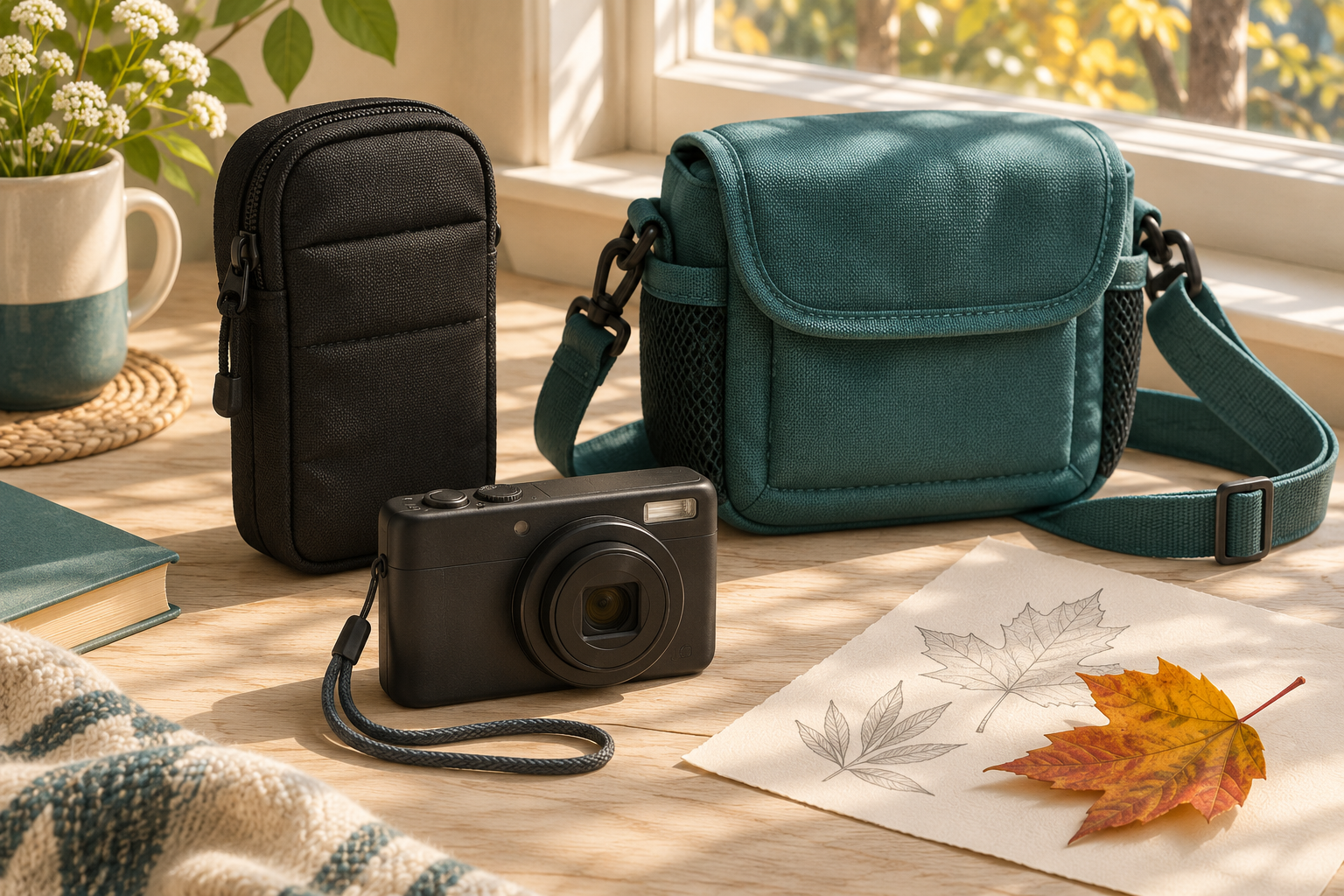
CS 20 has a 7.8 × 3.5 × 13 cm interior, weighs 58 g and includes a front pocket, belt loop and attachable shoulder strap. Measure camera depth carefully.
Lowepro Tahoe CS 20 Camera Case, Black
For an ultra-compact camera on a lightly packed family photo walk.
Find in Amazon (paid link)
CS 80 has a 13.5 × 8 × 13 cm interior, weighs 128 g and has front accessory and rear photo pockets. Check your exact camera and attached lens for fit.
Lowepro Tahoe CS 80 Camera Case, Black
For a larger camera or a little more room for supplies.
Find in Amazon (paid link)
A quick measuring job before the adventure
Switch the camera off and let any retracting lens finish moving. Measure the complete body, including a protruding grip, lens cap, and anything that will stay attached in the case. Record width, height, and depth on paper. Compare those measurements with the case’s internal dimensions, keeping the orientation consistent. External dimensions describe the bag’s footprint, not the usable camera space.
Do not choose a case whose fit depends on stretching its sides or pressing the zipper across the lens. Leave enough practical clearance to guide the camera in without force. A removable strap also needs somewhere to sit without catching in the closure. If your camera has a fixed projecting lens or a bulky protective shell, its depth may rule out the smaller pouch immediately.
CS 20 keeps a little kit together
CS 20 suits the little-camera, little-kit approach. You might keep the pouch inside your daypack alongside the family’s other things, bringing it out at each photo stop. Your child can concentrate on spotting a pattern or a bright colour while you handle the bag. The narrow compartment is useful only when the camera fits comfortably; it is not a reason to squeeze a bigger body into a smaller space.
Keep the packing plan simple enough to remember. A camera should slide in without pressure on its lens, and the front pocket should not press hard objects against it. An opening that admits the camera does not prove the compartment is a good fit. Your child is more likely to put the camera away carefully when there is room to guide it in, rather than a puzzle to solve every time you move on.
CS 80 gives a larger camera room
CS 80 is worth a look when the camera genuinely needs a deeper compartment or the outing calls for a few photo supplies. The extra space may make packing easier, but it does not need filling. Decide what you will carry before buying. A short leaf-and-shadow mission can stay light, leaving your child’s attention on discoveries along the path rather than a case full of things to juggle.
Check an instant camera’s fit carefully: instax mini is a film format, and the camera bodies come in different shapes. Our instant-camera size guide explains that distinction. The rear photo pocket is not a shortcut for handling fresh prints either. Let photographs develop and handle them according to the film instructions before finding a suitable place to keep those little treasures.
Rehearse the first photo stop
Practise packing at a table before the first walk. Let your child open the empty case and point out where the camera will go, then try it while an adult supports the camera. Notice a difficult zipper pull, a strap caught in the opening or a hand reaching for the lens. You can make this a quick rehearsal for the next photo stop, with no hurry and no camera balancing in mid-air.
The routine can stay small: stop walking, open the case with stable support or adult help, secure the camera appropriately, then take the photograph. Pack it before moving again. If carrying both camera and case is too much, you can be in charge of the bag while your child is in charge of noticing things. They still get the creative decisions without another object to manage.
Plan carrying before leaving home
Do not assume an included shoulder strap adjusts to a comfortable length for every child. Check the complete carrying setup with the case loaded, and follow the supplied instructions. Keep loose straps away from playground equipment, bicycle wheels, doors, and other places where they could catch. Remove the camera kit before active play and put it with the supervising adult.
Plan a short first route with a few safe places to stop. A bright colour, a rough texture and a leaf shape can become three photographs with a clear theme. Our fall-colour photo walk offers more ideas you can adapt. The case has done its job when packing feels straightforward enough to leave time for a small discovery and a photograph to remember it.
The care details for grown-ups
Lowepro describes padded construction and weather-resistant materials for these cases. Treat that as a reason for ordinary care, not permission to expose the kit to heavy rain, immersion, or deliberate drops. Keep the case away from puddles and wet ground. If the weather changes, put the kit somewhere dry and end the activity when necessary.
Empty the case after a sandy or muddy walk and inspect it before repacking. Separate food and drinks from camera equipment. Store spare batteries and memory cards appropriately rather than leaving them loose for young children to handle. Our parent’s camera-battery checklist helps establish who manages those small accessories.
Match the case to your camera
Write the camera’s height, width and depth beside the case’s internal measurements before ordering. Include its grip and anything that will stay attached. That quick grown-up check is what lets the finished kit feel simple for your child: a comfortable place for the camera, without forcing a lens past the zipper or leaving an important accessory nowhere to go.
We recommend CS 20 when its narrow interior comfortably holds your ultra-compact camera and a minimal kit. CS 80 is the better fit when extra depth solves a real packing problem. If neither fits, keep looking. A case should help your child enjoy the photo walk, with easy packing between discoveries and a sensible way for you to carry the equipment. That matters more than buying the smallest bag.